
Signs you need this
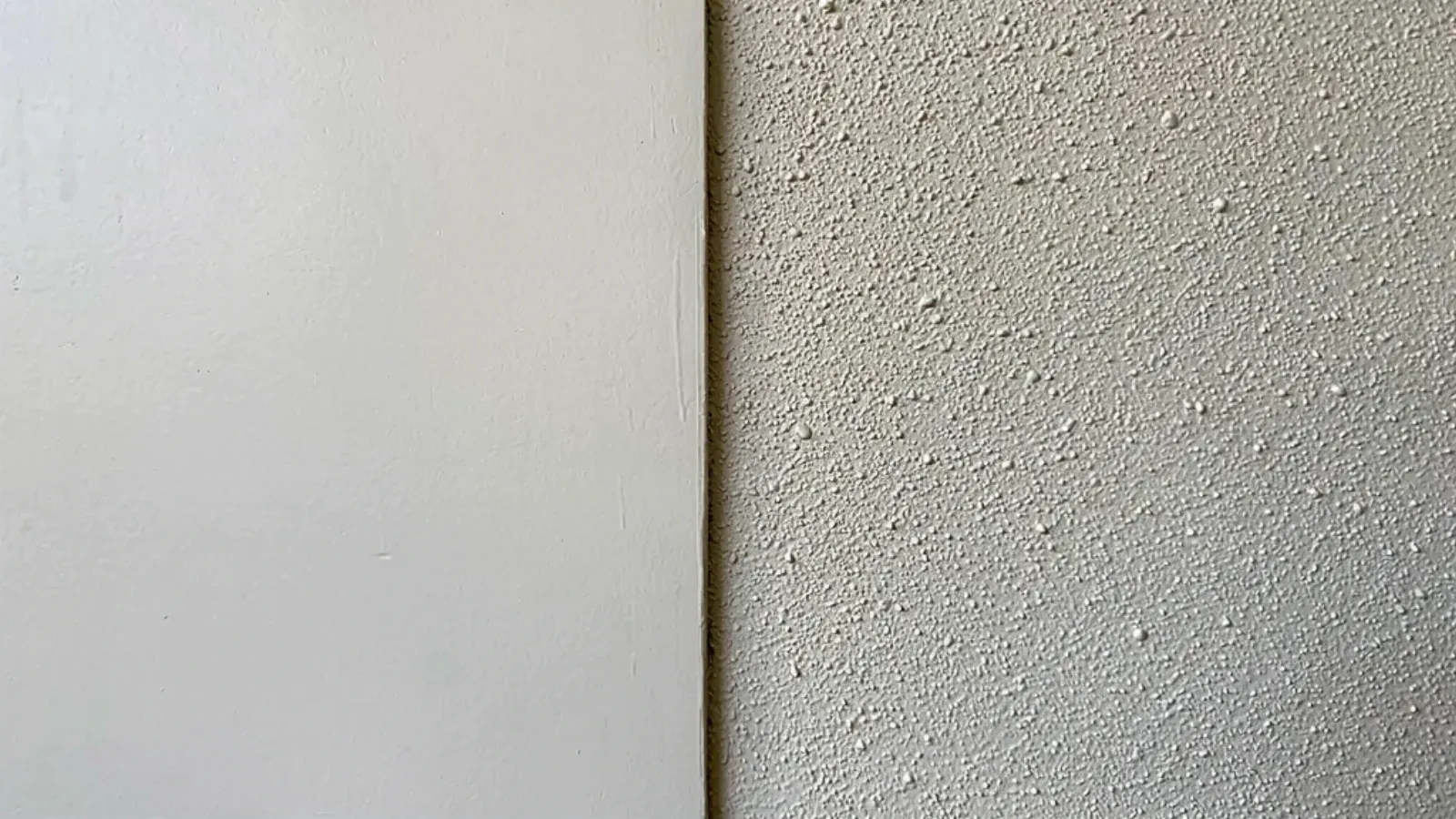
- • A patch on a wall or ceiling that's clearly flat and smooth while the surrounding surface has a knockdown, orange-peel, or hand-troweled texture
- • A repair from an outlet move, a small hole, or plumbing or electrical access that stands out as an obvious rectangle or blob against the rest of the wall
- • An older patch, sometimes done by a previous contractor or as a DIY fix, that still looks wrong months or years later
- • A visible seam or flat spot in an otherwise textured ceiling, especially noticeable under certain light
Why a good patch still looks wrong
A drywall patch can be structurally perfect, taped, mudded, and sanded flat, and still stand out the moment it’s painted. The reason is texture, not craftsmanship. Almost every wall and ceiling in Cambridge’s two- and three-family stock carries some kind of applied texture, most often a spray knockdown or orange-peel, and a smooth patch dropped into a textured field reflects light differently than the surface around it. Under a ceiling fixture or daylight from a window, that difference reads instantly, even from across the room. Cambridge Elite Drywall & Plaster treats texture matching as its own skill, separate from the structural repair, because a patch that’s invisible takes as much attention to the surrounding surface as it does to the hole being fixed.
Reading the existing texture before touching anything
Every textured wall has a pattern, even if it looks random at first glance. Knockdown texture starts as a heavier spray application that gets partially flattened with a wide knife while still wet, leaving irregular flattened peaks. Orange-peel is a finer, unflattened spray texture with a consistent stippled look. Older Cambridge buildings sometimes carry a hand-troweled or skip-trowel finish instead, applied by hand rather than sprayed, which tends to be more irregular and harder to replicate exactly. Before touching the actual patch, the crew studies the surrounding texture up close: the spacing between peaks, how heavy or light the application is, whether it’s a uniform factory pattern or an older, weathered variation. That read determines the spray pressure, nozzle, or hand technique needed to get a real match, and it’s usually tested on a scrap or an inconspicuous area first.
Where the seam actually hides
The technical part of a good texture match isn’t just spraying the right pattern onto the patch, it’s feathering that texture out past the edge of the repair so there’s no hard line where new meets old. A patch textured only within its own boundary, even with a perfect pattern match, still shows a faint outline where the two textures meet. Feathering the new texture slightly onto the surrounding original surface blurs that boundary so the eye can’t find the edge. This matters most on ceilings, where raking light from a window or a low fixture can pick out even a subtle transition that would go unnoticed on a wall.
Fixing what’s underneath first
Not every mismatched patch is a texture problem alone. Sometimes the tape and mud work beneath a previous repair wasn’t done well, leaving a slightly raised or uneven surface that no amount of texture matching will fully disguise. Cambridge Elite Drywall & Plaster checks the underlying patch before texturing over it, and if it needs to be reworked, that happens first. Texturing over a flawed base just replicates the flaw with a pattern on top of it.
A small job that finishes a bigger one
Texture matching is often the last step in a repair that started somewhere else entirely, a water leak that got cut out and patched, an electrician’s access hole, a plumbing fix that opened a section of wall. The structural work gets the wall closed up and sound again, but the room doesn’t feel finished until the patch disappears. That’s the point of this service: not a repair on its own, but the step that makes an earlier repair invisible, so the wall or ceiling reads as one continuous surface rather than a fix that happened at some point.
Materials & standards
Products & materials we use
- USG Sheetrock
- National Gypsum Gold Bond
- FibaTape
Standards & codes we work to
- ASTM C1396
- MA 780 CMR (Massachusetts State Building Code)
- Massachusetts Construction Supervisor License (CSL)
- Massachusetts Home Improvement Contractor (HIC) registration
What the terms mean
- Knockdown texture
- Orange-peel
- Joint compound
- Mud and tape
- Corner bead
- Feathering
- Hand-troweled finish
- Skip-trowel
Options & variants
| Option | When it applies | Cost |
|---|---|---|
| Knockdown texture match | Most common texture on Cambridge two- and three-family ceilings and walls | Lower to moderate |
| Orange-peel texture match | Finer, spray-applied texture common on some walls | Lower to moderate |
| Hand-troweled or skip-trowel match | Older or custom finishes, harder to replicate | Moderate to higher |
| Feathering a flat patch into a lightly textured wall | Subtle original texture where a full spray match isn't needed | Lower |
What affects cost
- • The size of the patch area needing texture work
- • How close a match is needed, since an older hand-applied texture is harder to replicate than a uniform factory pattern
- • Whether the existing texture is a standard spray pattern or an aged, weathered variation that takes trial and adjustment
- • Ceiling versus wall access, since overhead texture work takes more setup
- • Whether a previous failed patch has to be removed and redone before new texture can go on
What to expect
- 1
Call and describe the patch
You call and describe the patch, ideally with a photo of the area and the surrounding texture. Cambridge Elite Drywall & Plaster gets a first read on what technique will be needed.
- 2
Study and test the pattern
The crew visits, examines the existing texture pattern up close, and tests spray or hand-troweling technique to find the right match before touching the actual wall.
- 3
Fix the base if needed
If the underlying patch isn't already sound, the crew fixes the tape and mud work first.
- 4
Apply and feather
Matching texture, whether sprayed knockdown, orange-peel, or hand-troweled, is applied to the patched area and feathered into the surrounding surface so the transition disappears.
- 5
Prime and touch up
The area is primed and touched up so the seam between old and new is invisible once painted.
When this isn’t the right call
- If an entire ceiling's popcorn or acoustic texture needs to come off, not just a small patch, that's popcorn ceiling removal.
- If the goal is converting a whole wall to a flat, modern Level 5 finish rather than matching existing texture, that's a full skim coat.
- If the underlying issue is an active water leak or visible mold rather than a cosmetic texture mismatch, that's water damage drywall repair or mold drywall replacement.
Frequently asked questions
Can you really make a patch invisible? +
In most cases, yes, especially with a standard knockdown or orange-peel pattern. A close match depends on studying the existing texture carefully and testing the technique before applying it to the real patch, which is exactly what Cambridge Elite Drywall & Plaster does first.
What if nobody knows what texture technique was originally used? +
That's normal, especially in older buildings. The crew examines the pattern itself, the spacing, the depth, the direction, and works backward to the spray or trowel technique that would produce it, then tests on a sample area before committing to the real patch.
Does texture matching work on ceilings as well as walls? +
Yes. Ceiling texture matching follows the same process as walls, though the overhead work and any furniture or fixtures below need to be protected first.
How long after the patch is taped and mudded can you texture it? +
The joint compound needs to be fully dry and sanded smooth before texture goes on. Depending on the patch size, that's usually a short wait, not a long one, and Cambridge Elite Drywall & Plaster sequences the work so there's minimal downtime between steps.
My previous contractor's patch already looks bad. Can that be fixed? +
Often, yes. If the underlying tape and mud work is sound, the crew can texture over it to match the surrounding surface. If the original patch itself is poorly done, it may need to be redone first before texture goes on.
Do I need to repaint the whole wall, or just the patched area? +
Texture matching alone doesn't require repainting the whole wall, but paint sheen can show a difference between old and new paint even with a perfect texture match. Many owners choose to repaint the full wall for a completely uniform look, though it's not always necessary.