
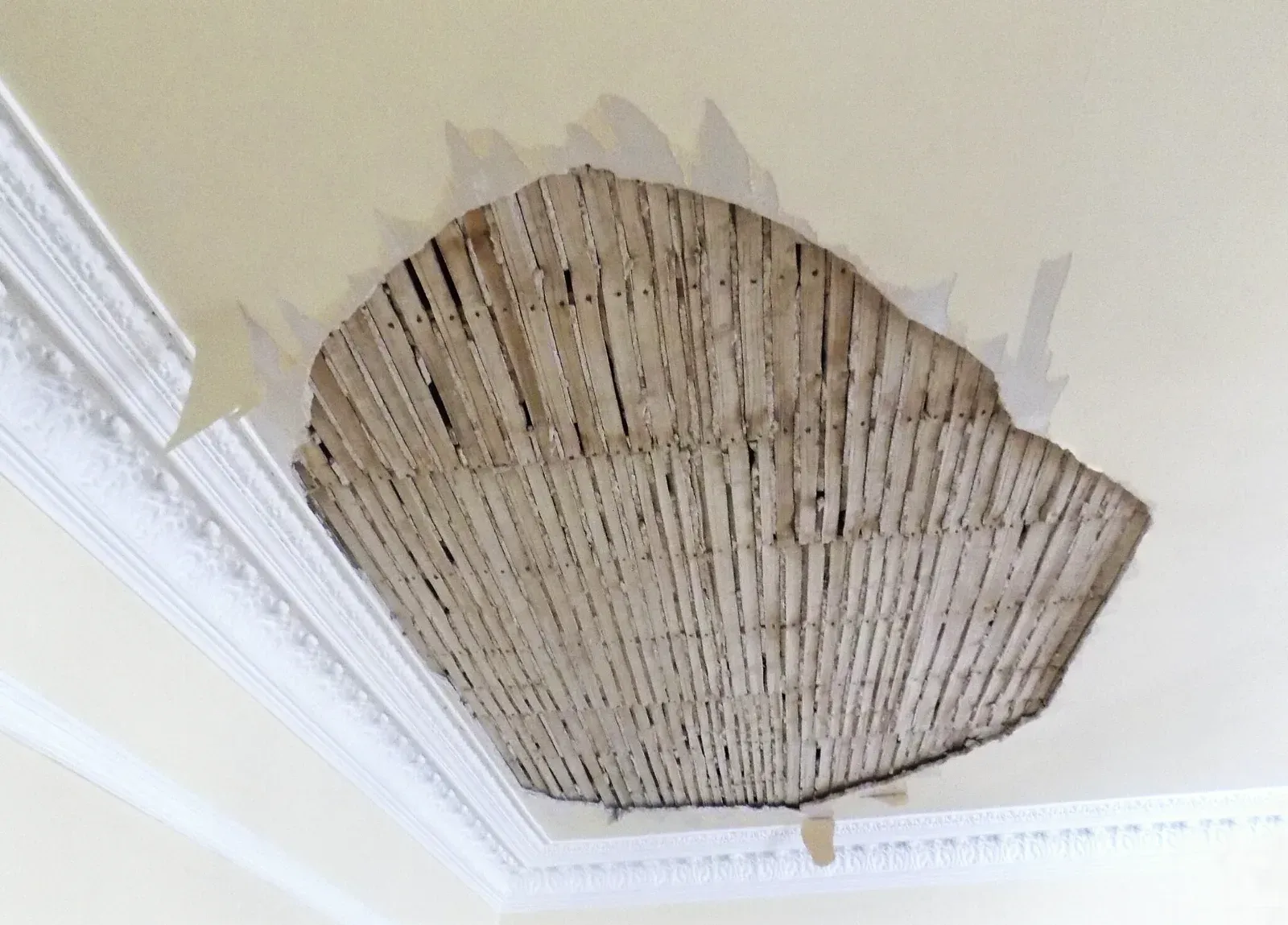
Signs you need this
- • Spidery hairline cracks that keep coming back over the same spot no matter how many times it gets patched
- • Sections of plaster that feel loose or hollow when tapped, meaning the plaster has pulled away from the wood lath behind it
- • Plaster that has bulged, cracked in a long line, or fallen away from a ceiling in chunks
- • Rough, wavy walls where old repairs never blended and the surface looks patched rather than smooth
- • Nail pops, corner damage, or crumbling plaster around a doorway or window in an older home
Why old Cambridge plaster fails, and what to do about it
Before drywall, walls in Cambridge were built with plaster spread over thin wood strips called lath. The plaster oozed between the lath and hardened into keys that lock it in place. Over a century those keys crack and break, the plaster loosens from the lath, and the wall starts to move independently of the finish on top of it. That is the real story behind the hairline cracks that keep coming back and the hollow sound when you tap certain spots. Cambridge Elite Drywall & Plaster works on these walls constantly, because the city holds an enormous stock of 1850 to 1925 Victorians, Colonials, and Greek Revivals with their original lath-and-plaster interiors still in place.
Old Cambridge and Avon Hill are full of these homes, and the walls there were never meant to be patched at the surface and forgotten. A painter’s quick fill over a crack looks fine for a season, then the same line reappears because nothing addressed the failed keys underneath. The choice on every old wall comes down to two paths: save the plaster and make it right, or convert it to drywall.
Saving the plaster
When the plaster is still largely bonded to the lath, the better move is to keep it. Original plaster is thicker and harder than drywall and it carries the character of the house. The crew re-anchors loose sections, cuts out and rebuilds cracked areas, then skims the surface with joint compound to level everything into one plane. For an owner who wants the finest result, a full skim coat brings the whole wall to a Level 5 finish, smooth enough that raking light and deep flat paint colors show no seams. This historic-sensitive skim over lath is the approach that respects a period home instead of stripping its walls out.
Converting to drywall
Sometimes the plaster is too far gone. When large areas are loose, when a ceiling has begun to detach, or when a wall is already opened up for a renovation, converting to drywall is the more durable and cost-effective answer. The crew removes the old plaster and lath, checks and repairs the framing behind it, then hangs, tapes, and finishes new drywall to the original wall lines. The trim, the moldings, and the proportions of the room stay exactly as they were, so a converted wall still reads as the old house rather than an obvious modern insert. Plaster-to-drywall conversion also gives an owner a good moment to add insulation or run new wiring while the cavity is open.
Working under Cambridge Historical Commission review
A large share of this work happens on homes under formal historic review, including the Old Cambridge Historic District, Half Crown–Marsh, the Harvard Square Conservation District, and the Mid-Cambridge and Avon Hill neighborhood conservation districts. Repairs on those homes have to respect the building’s character, which is why plaster-sensitive craftsmanship is a scarce specialty rather than general handyman work. Cambridge Elite Drywall & Plaster keeps original details intact and does the work in a way that holds up to that scrutiny, from West Cambridge and Brattle Street down through Mid-Cambridge.
Lead-safe work on pre-1978 homes
Nearly every historic Cambridge home predates 1978, which means the paint over the plaster can contain lead. Sanding or demolishing those surfaces without control spreads lead dust through the house. The company works as an EPA RRP Lead-Safe Certified Firm and sets up proper containment before disturbing old painted plaster, following MA 780 CMR and RRP rules. That protects the household and keeps a careful restoration from becoming a contamination problem. Whether the answer is a skim coat that saves the original wall or a clean conversion to drywall, the goal is the same: an old Cambridge home with walls that finally stay right.
Materials & standards
Products & materials we use
- USG Sheetrock
- National Gypsum Gold Bond
- CertainTeed
- Georgia-Pacific ToughRock
- FibaTape
Standards & codes we work to
- MA 780 CMR (Massachusetts State Building Code)
- ASTM C1396
- GA-214 finish Levels 0-5
- EPA RRP lead-safe work practices for pre-1978 housing
- Massachusetts Construction Supervisor License (CSL)
- Massachusetts Home Improvement Contractor (HIC) registration
- EPA RRP Lead-Safe Certified Firm
What the terms mean
- Lath and plaster
- Skim coat
- Level 5 finish
- Historic-sensitive skim over lath
- Joint compound
- Mud and tape
- Corner bead
- Plaster-to-drywall conversion
- Knockdown texture
Options & variants
| Option | When it applies | Cost |
|---|---|---|
| Crack repair and skim over lath | Sound plaster with recurring hairline cracks | Lowest |
| Re-anchor and patch | Plaster has separated from the lath but is worth saving | Moderate |
| Full skim coat / Level 5 finish | Owner wants a flawless smooth wall across a whole room | Higher |
| Plaster-to-drywall conversion | Plaster is failing widely or a wall is being opened up anyway | Higher, varies with scope |
What affects cost
- • Whether the plaster can be saved and skimmed or has to come off and be replaced with drywall
- • The finish level requested, since a true Level 5 smooth wall takes more coats and labor than a standard finish
- • How much lath and framing repair is needed once the old surface is opened up
- • Protecting and working around original trim, moldings, and details in a period home
- • Lead-safe RRP containment on pre-1978 plaster, which nearly every historic Cambridge home falls under
What to expect
- 1
Call and describe the walls
You call and describe the walls, the age of the home, and whether it sits in a historic or conservation district. Cambridge Elite Drywall & Plaster arranges a look so it can judge whether to save or convert.
- 2
Assess save or convert
On site, the crew taps the plaster to find hollow and loose areas, checks the lath behind it, and recommends repair, full skim, or conversion for each wall or ceiling.
- 3
Protect and contain
The work area is protected and, on pre-1978 homes, set up with lead-safe RRP containment before anything is disturbed.
- 4
Repair or convert
For a repair, the crew re-anchors loose plaster, fills and rebuilds cracks and missing sections, then skims the surface to a smooth, even finish. For a conversion, old plaster and lath come out and new drywall goes up to the original wall lines.
- 5
Feather and prime
The surface is sanded, feathered into the surrounding walls and trim, and primed so the room reads as one continuous, finished surface.
When this isn’t the right call
- If the plaster is stained and failing because of an active leak from above, that is water damage drywall repair, not a plaster job.
- If the wall is damp and growing mold behind the plaster in a below-grade room, that calls for mold drywall replacement.
- If you only need a single small nail pop or hairline crack filled before painting, a painter can usually handle that without a full plaster scope.
Frequently asked questions
Should I repair my plaster or just convert it to drywall? +
It depends on how much of it is still sound. If the plaster holds to the lath and only cracks at the surface, re-anchoring and skimming keeps the original character at a lower cost. When plaster is loose or failing across large areas, converting to drywall is usually the more durable and cost-effective choice.
Why do my plaster cracks keep coming back after I patch them? +
A surface patch does not fix the cause. Old plaster cracks because it has separated from the wood lath behind it, so the movement continues under the filler. Re-anchoring the plaster or skimming the whole surface addresses the movement instead of the symptom.
My house is in a historic district. Can you still do this work? +
Yes. Cambridge Elite Drywall & Plaster does plaster-sensitive work on homes under Cambridge Historical Commission review and keeps original trim, moldings, and wall lines intact so repairs respect the home's character.
What is a Level 5 finish and do I need it? +
A Level 5 finish is a full skim coat over the entire surface that gives a flawless smooth wall with no visible seams. It matters most on walls lit by raking light or painted a deep flat color. For a standard room a lower finish level often looks just as good for less.
Is lead a concern in my old plaster walls? +
In most pre-1978 Cambridge homes, yes. Disturbing old painted plaster can release lead dust, so the company works as an EPA RRP Lead-Safe Certified Firm and sets up containment before disturbing those surfaces.
Will a converted drywall wall still match my old rooms? +
Yes. The crew brings the new drywall to the original wall lines and works carefully around existing trim and moldings, so a converted wall reads as part of the period home rather than an obvious modern patch.