
Signs you need this
- • Conversations, TV dialogue, or music from the next unit coming through a shared wall clearly enough to follow
- • Footsteps, dragged furniture, or a dog running overhead from the unit above in a converted two- or three-family
- • Bass and low-frequency sound from a neighbor's speakers or a home theater carrying through a party wall or floor
- • A home office, nursery, or bedroom sitting on the wrong side of a noisy shared wall or stairwell
Why sound travels so easily through a Cambridge party wall
Cambridge’s housing stock works against quiet living in a specific way. So much of the city’s two- and three-family stock in Cambridgeport, Inman Square, and North Cambridge was built as a single-family frame, then divided into condos and rental units decades later. The wall or ceiling separating those units was rarely built to isolate sound between two separate households, because it was never meant to be a party wall in the first place. A single layer of standard board on wood studs carries voices, TV bass, and footsteps far more readily than a wall engineered for isolation from the start. Cambridge Elite Drywall & Plaster builds the assembly that wall should have had, working around the framing and finishes already in place.
What actually blocks sound
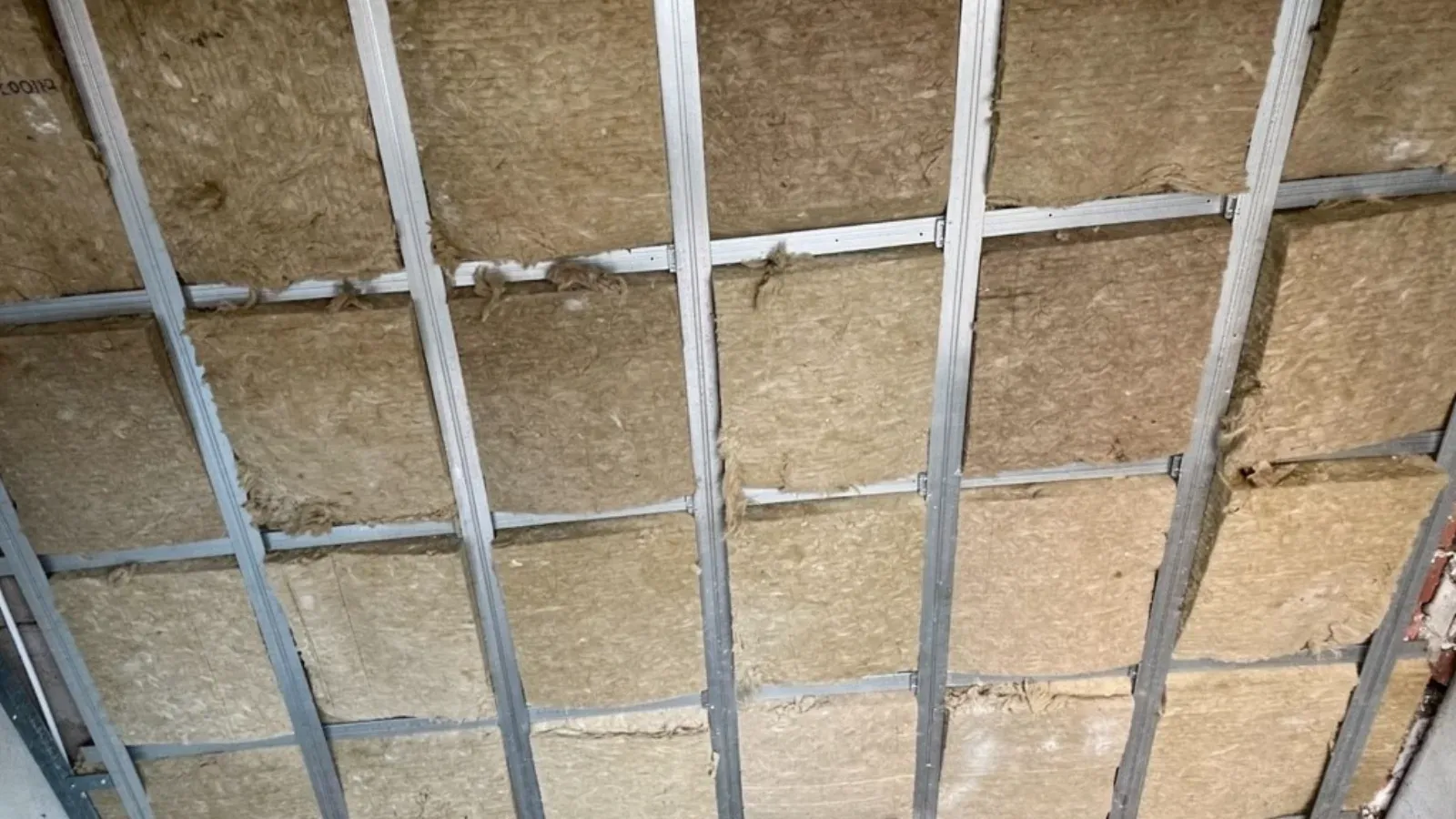
Sound moves through a wall two ways: as vibration through the solid structure, and as air leaking through small gaps. A standard wall assembly does little to interrupt either path, which is why simply adding a thicker layer of drywall only helps so much. Resilient channel breaks the direct connection between the drywall and the studs, so vibration has to cross an air gap instead of traveling straight through solid wood. QuietRock is a purpose-built sound-isolation board with a damped core that absorbs vibration within the panel itself, useful where wall thickness is tight and there’s no room to add a full second layer. Green Glue is a viscoelastic damping compound applied between two layers of drywall; as the layers flex slightly against each other, the compound converts vibration into a small amount of heat instead of passing it through. Combining resilient channel or QuietRock with a Green Glue double-layer assembly gets the biggest jump in isolation, and the right combination depends on how much the wall can be opened up and what the target sound reduction is.
Sealing the paths sound sneaks through
A well-built assembly can still underperform if sound leaks around it. Electrical outlets and switch boxes cut straight through a wall’s cavity, and an unsealed outlet on a party wall can undo a meaningful share of an otherwise good assembly’s isolation. The same goes for any pipe, duct, or wire penetration. Cambridge Elite Drywall & Plaster seals these flanking paths as part of every soundproofing job, using acoustic sealant and, where needed, offsetting or boxing outlets so they don’t line up directly with a matching outlet on the other side of the wall.
Working in occupied condos and two-family units
Most soundproofing jobs in Cambridge happen in a unit that’s still occupied, and often the wall in question is shared with a neighbor who has their own schedule and, in a condo, their own association rules. The crew scopes the work to the room and wall in question, protects the rest of the space, and keeps the footprint of the job contained so the household can keep living in the rest of the unit. Where a wall is a shared party wall between two condo units, Cambridge Elite Drywall & Plaster works from whatever the building’s association requires, since that approval process varies building to building.
Matching the finish so the wall looks untouched
Once the assembly is in, the wall gets taped, finished, and textured to match whatever was there before, whether that’s a smooth painted surface or a knockdown ceiling. A soundproofed wall should look identical to the rest of the room. It’s just quieter, and that’s the entire point: the household on the other side stops being part of the daily soundtrack.
Materials & standards
Products & materials we use
- QuietRock
- Green Glue
- USG Sheetrock
- National Gypsum Gold Bond
- Resilient channel
Standards & codes we work to
- MA 780 CMR (Massachusetts State Building Code)
- ASTM C1396
- ISO (STC rating context)
- Massachusetts Construction Supervisor License (CSL)
- Massachusetts Home Improvement Contractor (HIC) registration
What the terms mean
- STC rating
- Sound isolation
- Party wall
- Demising wall
- Resilient channel
- Green Glue damping
- Flanking path
- Type X
Options & variants
| Option | When it applies | Cost |
|---|---|---|
| Resilient channel with standard board | Moderate noise reduction needed, budget-conscious | Lower cost |
| Double-layer drywall with Green Glue | Better sound isolation without a major change in wall thickness | Moderate cost |
| QuietRock single-layer replacement | Best isolation per inch of wall thickness, tight spaces | Higher cost |
| Full assembly rebuild, wall opened to add mass and isolation | Wall is already open for other work, or the existing assembly is minimal | Highest, varies with scope |
What affects cost
- • Whether the job is a ceiling, which usually means more access work, or a wall
- • How much of the existing wall or ceiling has to be opened versus building over what's there
- • The target sound reduction, since a home theater wants a bigger jump than a bedroom next to a quiet hallway
- • How many outlets, switches, and other penetrations need to be sealed as flanking paths
- • Whether the work is coordinated with a condo association or a shared party wall with a neighbor
What to expect
- 1
Call and describe the noise
You call and describe where the noise is coming from, which wall or ceiling it crosses, and what you're hoping to achieve. Cambridge Elite Drywall & Plaster schedules a look at the space.
- 2
Assess the existing assembly
The crew identifies the existing wall assembly, estimates how much sound it currently blocks, and recommends resilient channel, QuietRock, Green Glue, or a combination based on the goal and budget.
- 3
Protect and open the wall
The room is protected and, if the wall needs to come open, the existing board is removed down to the studs.
- 4
Build the new assembly
Resilient channel or QuietRock board goes in, Green Glue between layers where specified, and every outlet, switch, and penetration is sealed to close flanking sound paths.
- 5
Finish to match
The wall is taped, finished, textured to match the surrounding surface, and primed, so the room looks the same as before, just quieter.
When this isn’t the right call
- If the wall is fine acoustically but has a cracked or damaged patch that just needs to blend in visually, that's texture matching, not soundproofing.
- If the concern is water staining or active moisture rather than noise, that calls for water damage drywall repair.
- If the wall is original lath-and-plaster and the goal is repair or historic-sensitive restoration rather than sound isolation, that's plaster repair or a plaster-to-drywall conversion.
Frequently asked questions
How much quieter will my wall actually be? +
It depends on the starting assembly and what's installed. A standard wall with resilient channel and an added layer of board typically cuts a noticeable amount of noise; QuietRock or a full double-layer Green Glue assembly goes further. Cambridge Elite Drywall & Plaster can walk through realistic expectations for your specific wall during the site visit.
Do you have to open up the whole wall? +
Not always. Resilient channel and an added layer of board can sometimes go over the existing surface. A full QuietRock replacement or a Green Glue double-layer assembly usually means removing the existing board first to keep the wall from getting too thick.
Does this help with footsteps from upstairs, or just voices and TV noise? +
Airborne noise like voices, TV, and music responds well to a wall or ceiling assembly upgrade. Footsteps and impact noise are harder to fully solve from the ceiling side alone, since they travel through the floor structure above; a ceiling assembly still helps, but the biggest gains for impact noise usually come from the flooring side.
Can this be done without me moving out? +
Yes, in most cases. Soundproofing one or two walls or a ceiling in a single room is contained work, and you can typically stay in the rest of the home while it's underway.
Do I need my condo association's approval for this kind of work? +
If the wall in question is a shared party wall with another unit, check your association's rules before scheduling. Cambridge Elite Drywall & Plaster can work from whatever plan the association requires once it's approved.
Why does a ceiling cost more to soundproof than a wall? +
Ceiling work usually means working overhead, often with furniture or fixtures to protect below, and any existing texture has to be matched afterward. That access and finish work adds labor compared to a straightforward wall.