
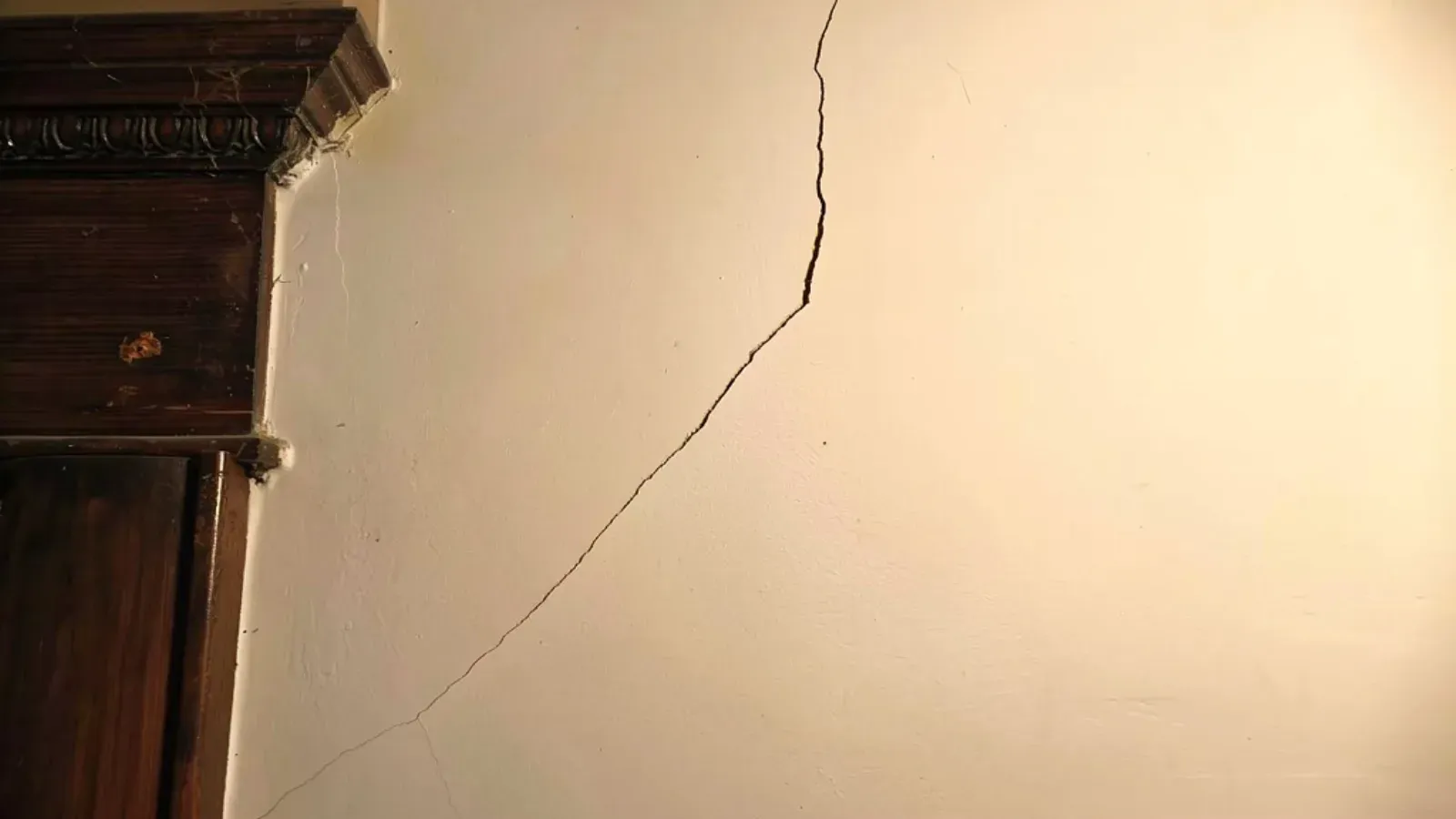
Signs you need this
- • A hairline crack at a corner bead that keeps coming back after being filled and painted over
- • A diagonal crack running from the corner of a doorway or window, a classic settling sign
- • A crack that follows a straight line along a taped seam where two pieces of drywall meet
- • A crack that visibly opens wider in winter and closes back up by summer, or the reverse
- • A stress crack over a stairwell or at the point where an addition meets the original structure
Why a crack you already filled keeps coming back
A crack that reopens in the same spot after being filled is telling you something a fresh crack doesn’t: whatever caused it the first time never stopped. Cambridge Elite Drywall & Plaster treats a recurring crack as a diagnostic problem before it’s a cosmetic one, because filling the surface again without addressing the cause just buys another year before it reopens.
Settling versus seasonal movement
Two different forces cause most recurring cracks in Cambridge homes, and they call for different fixes. Building settling is slow and largely one-directional: an older triple-decker or two-family home in Cambridgeport or The Port continues shifting slightly on its foundation for decades after it’s built, and a diagonal crack running from a door or window corner is often that movement working itself out through the weakest point in the wall. Seasonal movement is cyclical instead: wood framing expands and contracts with humidity and temperature, so a crack along a taped seam can visibly widen in a dry winter and close back up by summer. A repair aimed at settling needs to accommodate ongoing movement, while a seasonal crack needs a properly embedded seam that can flex without failing.
Corner bead: the usual suspect
More recurring cracks trace back to corner bead than any other single cause. The metal or vinyl strip that protects and shapes an outside corner can bend from an impact, pop loose from its fasteners, or simply fail with age, and once that happens the corner has nothing rigid to hold its line. Mudding over a failed bead hides the problem for a few months at most. Cambridge Elite Drywall & Plaster pulls and replaces the bead itself in these cases, which is the difference between a repair that lasts and one that’s back on the schedule next year.
Taping failure and how it’s fixed properly
Every seam in a drywall wall is held together by tape embedded in joint compound, and a crack that runs perfectly straight along one of those seams usually means the tape itself has lifted or was never fully embedded when the wall was hung. The fix isn’t more compound over the same failed tape, it’s cutting the seam back, removing the old tape, and re-embedding fresh fiberglass mesh or paper tape under proper pressure before building the joint back up in thin coats. Skipping that step is the single most common reason a “repaired” crack is back within a year.
Two-family and triple-decker specifics
Cambridge’s dense stock of wood-frame two- and three-family homes, concentrated in Cambridgeport, The Port, and Inman Square, settles differently than a single-family house because of how those buildings were framed and how many units share the same structure. Stress cracks over stairwells and at the seams where later additions meet the original frame are common enough that the crew treats them as expected rather than alarming, but they’re also exactly the cracks that need a control joint or reinforced repair rather than a simple fill, since the movement causing them is still ongoing.
Materials & standards
Products & materials we use
- USG Sheetrock
- National Gypsum Gold Bond
- CertainTeed
- FibaTape
Standards & codes we work to
- MA 780 CMR (Massachusetts State Building Code)
- ASTM C1396
- GA-214 finish Levels 0-5
- Massachusetts Construction Supervisor License (CSL)
- Massachusetts Home Improvement Contractor (HIC) registration
What the terms mean
- Corner bead
- Fiberglass mesh tape
- Paper tape
- Control joint
- Taping failure
- Seasonal movement
- Settling crack
- Joint compound
- Mud and tape
Options & variants
| Option | When it applies | Cost |
|---|---|---|
| Surface crack fill and repaint prep | Hairline, non-recurring crack, purely cosmetic | Lowest cost |
| Corner bead replacement | The metal or vinyl bead itself is bent, cracked, or popped loose | Moderate |
| Reinforced tape reset | Crack along a taped seam that keeps reopening after prior fills | Moderate |
| Structural movement crack repair with control joint | Ongoing settling in an older two- or three-family home where the crack is expected to keep moving seasonally | Higher |
What affects cost
- • Whether the crack is in drywall or original plaster, since plaster crack repair is more specialized
- • The length and location of the crack, with cracks over doorway and window openings being a common stress point
- • Whether the corner bead itself needs replacing or can simply be resealed
- • How many cracks are being addressed in the same room or unit
- • Whether a control joint needs to be added to accommodate movement that's still ongoing
What to expect
- 1
Look at the crack pattern
Cambridge Elite Drywall & Plaster looks at the crack's shape and location and asks how long it's been there and whether it's come back before.
- 2
Identify the cause
The crew identifies the likely cause: building settling, seasonal movement, or a taping or fastener failure from a prior repair.
- 3
Cut back and remove failed material
The area is cut back along the crack, and any failed tape or bead is removed.
- 4
Reinforce
The seam is reinforced with properly embedded tape or new bead and built up in several thin coats of joint compound.
- 5
Sand, texture, and prime
The repair is sanded, texture-matched, and primed, ready for paint.
When this isn’t the right call
- If the damage is a fresh hole or dent rather than a crack, that's drywall repair and patching, not a crack fix.
- If the crack came with an active leak or a spreading water stain, that's water damage repair, not a settling or seasonal crack.
- If the crack is on original lath-and-plaster and the goal is a broader plaster restoration or conversion, that's a plaster repair or conversion job, not a standard crack fix.
Frequently asked questions
Why does the crack keep coming back after I fill it myself? +
A DIY fill usually just bridges the surface without addressing what's underneath. If the cause is a bent corner bead or ongoing settling, plain spackle has nothing to hold onto and the crack reopens as soon as the building moves again.
Is a recurring crack a sign of a structural problem? +
Not always. Many recurring cracks come from normal seasonal expansion and contraction or a corner bead that was never properly seated, not from a serious structural issue. The crew looks at the pattern and location to tell the difference.
Will the crack come back after your repair? +
A properly reinforced repair, with new tape or bead and a control joint where the wall is still moving, is built to flex with the building rather than crack again in the same spot.
What's actually wrong with a cracking corner bead? +
Corner bead can bend, pop loose from the corner, or simply age out, and once it's compromised, filling over it just delays the crack from reappearing. Replacing the bead is what actually fixes it.
I have cracks over a doorway and a window in the same room. Is that connected? +
Often, yes. Openings are stress points, and cracks radiating from them in the same room can point to the same underlying movement, which the crew checks for during the visit.
My home is an older triple-decker with a lot of small cracks. Should I worry? +
Older two- and three-family homes in Cambridge settle gradually over decades, and a scattering of hairline cracks is common rather than alarming. The crew can tell you which ones are cosmetic and which are worth reinforcing.