
Signs you need this
- • A section of ceiling that sags, bows, or feels soft when pressed lightly, without any active leak
- • An old brown water stain that stopped growing months or years ago but was never actually repaired
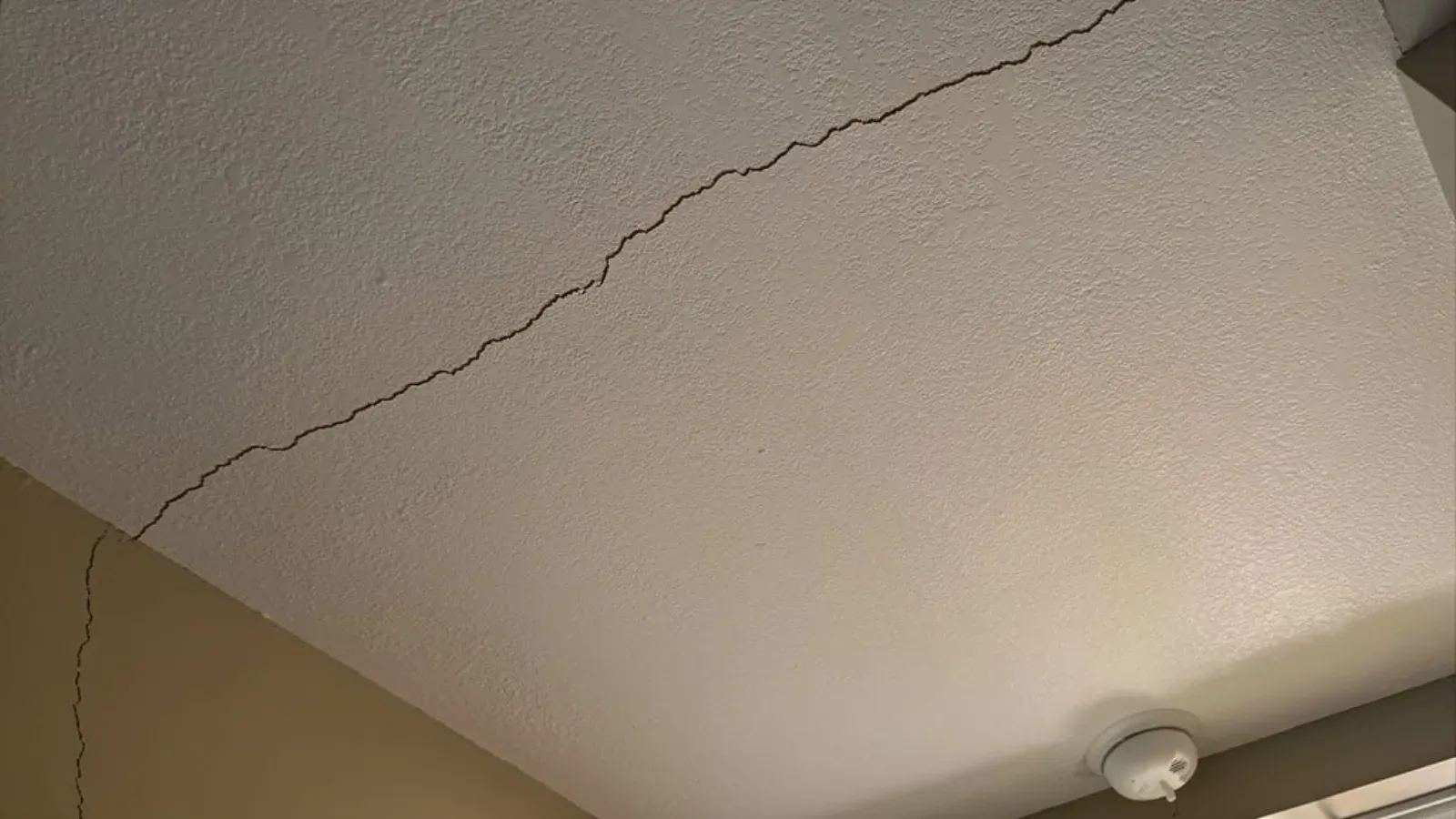
- • Cracks running across a plaster ceiling, often radiating from a light fixture or where two ceiling sections meet
- • Rows of small dimples or nail pops showing through the paint where fasteners have worked loose
- • A patched section from a prior repair that never got textured to match, reading as a flat scar overhead
Why ceilings fail differently than walls
A ceiling carries its own weight against gravity every day, so when the connection to the framing weakens, even slightly, the sag shows up overhead before it would ever show up on a wall. Cambridge Elite Drywall & Plaster sees this in two very different kinds of buildings across the city: newer drywall ceilings where the screws or nails have simply worked loose over time, and the much older plaster ceilings common in Old Cambridge and Avon Hill, where the plaster itself is losing its grip on the wood lath underneath. Both look similar from the floor, a soft or wavy patch overhead, but the fix is not the same, which is why the first step is always figuring out which one is happening.
Plaster ceilings and lost keys
Original plaster ceilings, common in the pre-1940 housing stock across Old Cambridge and Mid-Cambridge, were built by pushing wet plaster through gaps in wood lath strips, where it squeezed out the back and hardened into small clumps called keys. Those keys are what hold the whole ceiling up. Over decades of vibration, temperature swings, and settling, the keys shear off one by one, and once enough of them are gone the plaster starts to sag or drop in sheets. A hairline crack radiating from a light fixture is often the first visible sign that keys nearby have already failed. Repairing this properly means securing the loose plaster back to the lath, or in badly failed sections, removing the compromised area and rebuilding it, rather than just skimming over the crack and hoping it holds.
Access and the real cost driver
Ceiling work costs more than comparable wall work mostly because of access, not material. A stairwell ceiling, a cathedral ceiling in an addition, or a ceiling above a stairwell landing all need scaffolding or lift equipment just to reach the surface safely, and that setup time is often a bigger factor in the price than the size of the repair itself. Homes in Cambridgeport and North Cambridge with converted attic spaces frequently have sloped or vaulted ceiling sections that add another layer of access difficulty on top of the repair.
Matching texture so the repair disappears
A structurally sound repair that doesn’t match the surrounding texture still reads as a flat scar on the ceiling, which is one of the most common complaints Cambridge Elite Drywall & Plaster hears about prior patch jobs done elsewhere. Most Cambridge ceilings carry a texture, a smooth Level 5 finish in higher-end renovated units, a knockdown in mid-century homes, or an orange-peel in others, and each one has to be built up in layers and matched by hand before the patch blends in. On older plaster ceilings the crew also checks whether the surrounding paint predates 1978, since disturbing lead paint during the cut-out calls for EPA RRP lead-safe containment under MA 780 CMR. Getting both the structure and the finish right the first time is what keeps a ceiling repair from becoming a recurring line item.
Materials & standards
Products & materials we use
- USG Sheetrock
- National Gypsum Gold Bond
- CertainTeed
- Georgia-Pacific ToughRock
- FibaTape
Standards & codes we work to
- MA 780 CMR (Massachusetts State Building Code)
- ASTM C1396
- GA-214 finish Levels 0-5
- EPA RRP lead-safe work practices for pre-1978 housing
- Massachusetts Construction Supervisor License (CSL)
- Massachusetts Home Improvement Contractor (HIC) registration
- EPA RRP Lead-Safe Certified Firm
What the terms mean
- Lath and plaster
- Plaster keys
- Fastener pops
- Nail pops
- Joint compound
- Mud and tape
- Knockdown texture
- Orange-peel
- Level 5 finish
- Ceiling joist
Options & variants
| Option | When it applies | Cost |
|---|---|---|
| Fastener resecure and skim | Small localized sag from popped screws or nails, board otherwise sound | Lowest cost, fastest turnaround |
| Plaster ceiling key repair | Historic lath-and-plaster ceiling with hairline to moderate cracking from lost keys | Moderate, specialty plaster labor |
| Cut-out and section replacement | Sagging or damaged section beyond reattachment | Moderate to higher |
| Full ceiling texture rebuild | Restoring a smooth Level 5, knockdown, or orange-peel finish across the whole ceiling after a repair | Added labor for a full-surface match |
What affects cost
- • Ceiling height and access, including stairwells, cathedral ceilings, or rooms that need scaffolding
- • Whether the ceiling is original plaster or drywall, since plaster repair is more specialized labor
- • The size of the affected section and whether the cracking or sag is localized or spread across the ceiling
- • How complex the existing texture is to match, since a smooth Level 5 finish takes more skill than a knockdown or orange-peel
- • Whether the ceiling paint predates 1978, which calls for EPA RRP lead-safe containment during the cut-out
What to expect
- 1
Inspect and describe
Cambridge Elite Drywall & Plaster inspects the ceiling in person and asks what you've noticed and when it started.
- 2
Diagnose the cause
The crew runs a press test for sag, checks for any active moisture so it isn't mistaken for a live leak, and inspects how the board or plaster is attached to the framing.
- 3
Cut back and reattach
The affected section is cut back to sound material and reattached or replaced.
- 4
Tape and texture-match
The seams are taped, mudded, and the texture matched to the surrounding ceiling.
- 5
Prime paint-ready
The repair is primed and left ready for paint.
When this isn’t the right call
- If the ceiling is actively wet or a stain is still spreading, that's a water damage repair, not a standard ceiling job.
- If mold is already visible on the ceiling surface, that calls for mold drywall replacement.
- If cracks keep reappearing after being filled, on this ceiling or across several rooms, that points to a recurring crack issue rather than a one-time ceiling repair.
Frequently asked questions
Is a sagging ceiling dangerous? +
A ceiling that sags because fasteners have popped or plaster has lost its key isn't about to fall, but the strength that's already gone doesn't come back on its own. It's worth fixing before the sag gets worse or a corner lets go.
How do you know if my ceiling is plaster or drywall? +
Plaster feels harder and slightly cooler to the touch, and it's usually found in homes built before the 1950s. Cambridge Elite Drywall & Plaster checks this on the first visit, since it changes how the repair is done.
Can you match my exact ceiling texture? +
Yes. Whether it's a smooth painted finish, an orange-peel, or a knockdown, the crew rebuilds the texture on the patched section so it blends into the rest of the ceiling.
Do I need to move out during the repair? +
No, most ceiling repairs are done room by room while you stay in the home. The crew contains dust with plastic sheeting over the work area.
How long does a ceiling repair take? +
A localized repair is usually done in a day or two, plus drying time between coats. A full plaster ceiling or a large sagging section takes longer.
What if there's a light fixture or vent in the repair area? +
The crew works around fixtures and vents already in place, and reseats them once the surrounding ceiling is finished.