
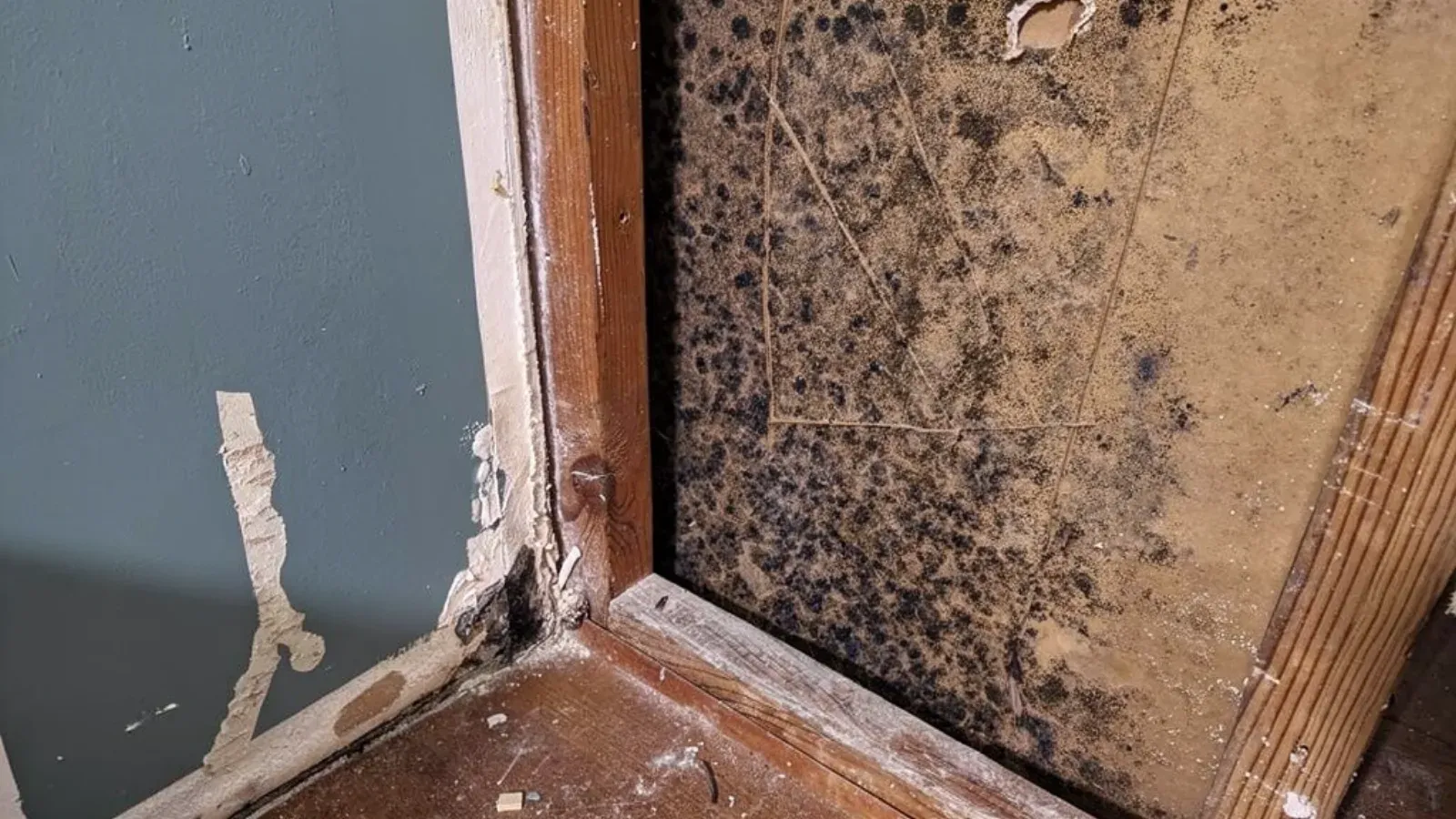
Signs you need this
- • Black, green, or gray spotting spreading across the lower part of a wall, often in a basement or bathroom
- • A persistent musty, earthy smell that stays in a room even when it looks clean
- • Drywall paper that is discolored, wrinkled, or soft where moisture has fed growth behind the surface
- • Family members with worsening allergy symptoms, congestion, or irritation that eases when they leave the room
- • Bubbling paint or a chalky white and dark residue near the floor line where a wall meets a damp slab
Why moldy drywall has to come out, not just get cleaned
Mold is a health problem first and a wall problem second. It grows wherever drywall stays damp, and the paper facing on standard drywall is food for it, so once growth takes hold inside that paper the board cannot be scrubbed back to safe. This is the point many homeowners miss. You can wipe mold off a hard surface, but a paper-faced wall holds the growth in the material and keeps releasing spores into the room. Cambridge Elite Drywall & Plaster removes the contaminated board rather than painting over it, because painting only hides growth that keeps spreading behind the surface.
Cambridge gives mold plenty of opportunity. The city is one of the densest in New England, and its lower-level rooms sit in ground that stays damp, especially near the Charles and out toward Alewife. Basement walls in North Cambridge and Inman, and the lower floors of the two- and three-family wood-frame homes across The Port, hold humidity long enough for growth to start along the base of a wall. Add a slow leak or poor ventilation and a small spot becomes a spreading patch. The health side is what usually triggers the call: a musty smell that will not leave, allergy symptoms that ease the moment someone leaves the room, or a family member with breathing trouble.
Removal with the growth kept contained
The first job is to stop spores from traveling through the house during the work. The crew keeps the affected area contained, then cuts out the moldy drywall and any wet insulation behind it and bags it for disposal. Insulation matters because damp batts hold moisture against the framing and can hide growth of their own. Cutting back to clean, dry framing is what keeps a hidden pocket of contamination from restarting the problem inside a finished wall.
For a small, contained patch on a wall that has dried out, this is a straightforward removal and rebuild. For a large area, or a home where someone has a serious health condition, the company coordinates with a mold remediation specialist who handles formal containment and post-work clearance, then Cambridge Elite Drywall & Plaster completes the drywall rebuild once the space is cleared. Knowing which situation calls for which approach is part of the assessment.
Fixing the moisture, then rebuilding with the right board
Mold cannot grow without moisture, so replacing the board without addressing the dampness just restarts the cycle. That is the single most common reason mold comes back on a basement wall. The crew works to understand the source, whether it is a damp slab, high basement humidity, or a leak, and confirms the cavity and framing are dry before closing anything up.
The rebuild itself is chosen for the conditions. In a basement, bath, or any wall that stays humid, the crew installs mold-resistant board such as purple M2Tech drywall, which uses a treated facing that resists growth far better than standard paper-faced gypsum. Where a wall meets wet conditions directly, cement board like Durock with a RedGard moisture barrier is the more durable base. New board is then taped, finished with joint compound, and primed to a clean, paint-ready surface. The work follows MA 780 CMR, and on the city’s large pre-1978 housing stock the company works as an EPA RRP Lead-Safe Certified Firm so that removing an old contaminated wall does not release lead dust in the process. The result is a wall that is not just patched but healthy, built to keep the mold from returning.
Materials & standards
Products & materials we use
- Purple mold-resistant board (M2Tech)
- USG Sheetrock
- National Gypsum Gold Bond
- CertainTeed
- Durock cement board
- RedGard
- FibaTape
Standards & codes we work to
- MA 780 CMR (Massachusetts State Building Code)
- ASTM C1396
- GA-214 finish Levels 0-5
- EPA RRP lead-safe work practices for pre-1978 housing
- MassDEP
- Massachusetts Construction Supervisor License (CSL)
- Massachusetts Home Improvement Contractor (HIC) registration
- EPA RRP Lead-Safe Certified Firm
What the terms mean
- Mold-resistant board
- Moisture-resistant
- Paper-faced drywall
- Joint compound
- Mud and tape
- Cavity drying
- Containment
- Cement board
Options & variants
| Option | When it applies | Cost |
|---|---|---|
| Cut-out and standard replacement | Small, contained surface growth on a dry-again wall | Lowest |
| Replacement with mold-resistant board | Basements, baths, and other spots that stay humid | Moderate |
| Full lower-wall removal and rebuild | Widespread basement or below-grade growth | Higher |
| Remediation-coordinated replacement | Large area or health-sensitive job needing specialist clearance | Higher, varies with scope |
What affects cost
- • How far the growth has spread and how much board and insulation must be removed
- • Whether the moisture source is a simple humidity issue or a deeper damp-basement problem to manage
- • The choice between standard drywall and mold-resistant board for the rebuild
- • Access in tight basement and utility spaces where framing and pipes are in the way
- • Whether the job is large or health-sensitive enough to bring in a remediation specialist for containment and clearance
What to expect
- 1
Call and describe the growth
You call and describe where the growth is, how large it looks, and whether anyone in the home has health concerns. Cambridge Elite Drywall & Plaster schedules an on-site look.
- 2
Assess and coordinate
The crew identifies the extent of the affected board, finds where the moisture is coming from, and, for larger or health-sensitive jobs, coordinates a remediation specialist for containment and clearance.
- 3
Contain and remove
Contaminated drywall and any wet insulation are cut out and bagged, with the area kept contained so spores do not spread through the home.
- 4
Fix moisture and dry
The moisture source is addressed, the cavity is dried, and the framing is confirmed dry before anything is closed up.
- 5
Rebuild with the right board
New drywall goes in, mold-resistant board where the area stays damp, and the surface is taped, finished, and primed ready for paint.
When this isn’t the right call
- If the drywall is simply water stained from a recent leak with no growth yet, that is water damage drywall repair.
- If the discolored surface is original lath-and-plaster in an old home rather than moldy drywall, that is plaster repair or a plaster-to-drywall conversion.
- If the growth covers a very large area or a household member has a serious health condition, a dedicated mold remediation firm should lead the containment, and the company then handles the drywall rebuild.
Frequently asked questions
Can you just clean the mold off my drywall instead of replacing it? +
Not reliably. The paper facing on drywall feeds mold and holds it in the material, so contaminated board has to be removed rather than cleaned. A hard surface like tile can be cleaned; paper-faced drywall cannot be brought back to safe.
Why does the mold keep coming back on my basement wall? +
Because the moisture is still there. Mold needs dampness to grow, so replacing the board without addressing a damp slab or high basement humidity just restarts the cycle. The moisture source has to be handled as part of the job.
What is mold-resistant board and should I use it in my basement? +
Mold-resistant board, such as purple M2Tech drywall, uses a treated, paper-light facing that resists growth. In a basement or any wall that stays humid, it is worth the small extra cost because it holds up far better than standard drywall.
Do you do the actual mold remediation? +
Cambridge Elite Drywall & Plaster removes and replaces the contaminated drywall. For large areas or health-sensitive homes, the company coordinates with a mold remediation specialist who handles containment and clearance, then does the drywall rebuild once the space is cleared.
Is black mold on my wall dangerous? +
Any mold spreading indoors affects air quality and can irritate breathing, and it is not something to paint over. The safe response is to get the affected drywall out and fix the dampness, rather than trying to judge the color yourself.
I need to turn over a rental unit with a moldy wall. How fast can this move? +
Contained replacement work can move quickly once the moisture source is understood. Call and describe the unit and the company prioritizes turnover jobs so the wall is clean and healthy for the next tenant.